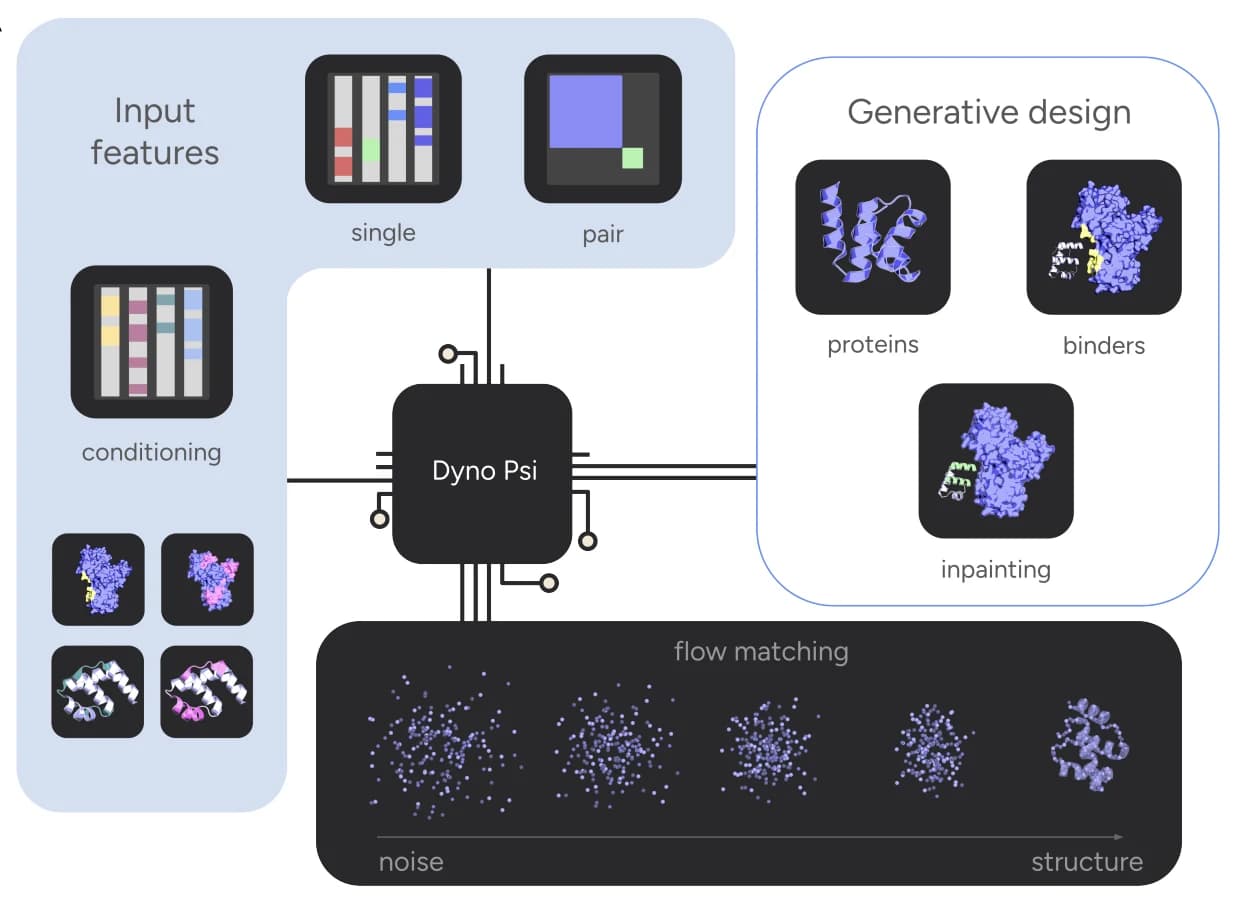
Dyno Psi is a family of generative models that harnesses recent advances in protein design to accelerate development for therapeutically relevant targets and modalities. It is a component of Dyno's overall approach to scalable, experimentally grounded sequence design, which couples generative design with high-fidelity, high-throughput assays to tailor general-purpose models and in silico screening pipelines to the problems that matter most to drug developers.
The whitepaper starts with Dyno Psi-0, a foundation model for protein design trained on a diverse set of generative tasks on Dyno SDI (Synthetic Domain Interfaces), a dataset of over 4 million real-world and synthetic multimer examples. It then shows that Dyno Psi-0 can be fine-tuned for benchmarking tasks such as miniprotein binder design and match the performance of other open-source state-of-the-art models. Dyno releases the model weights and inference code for this miniprotein binder design model, Dyno Psi-1, along with the training data for Dyno Psi-0.
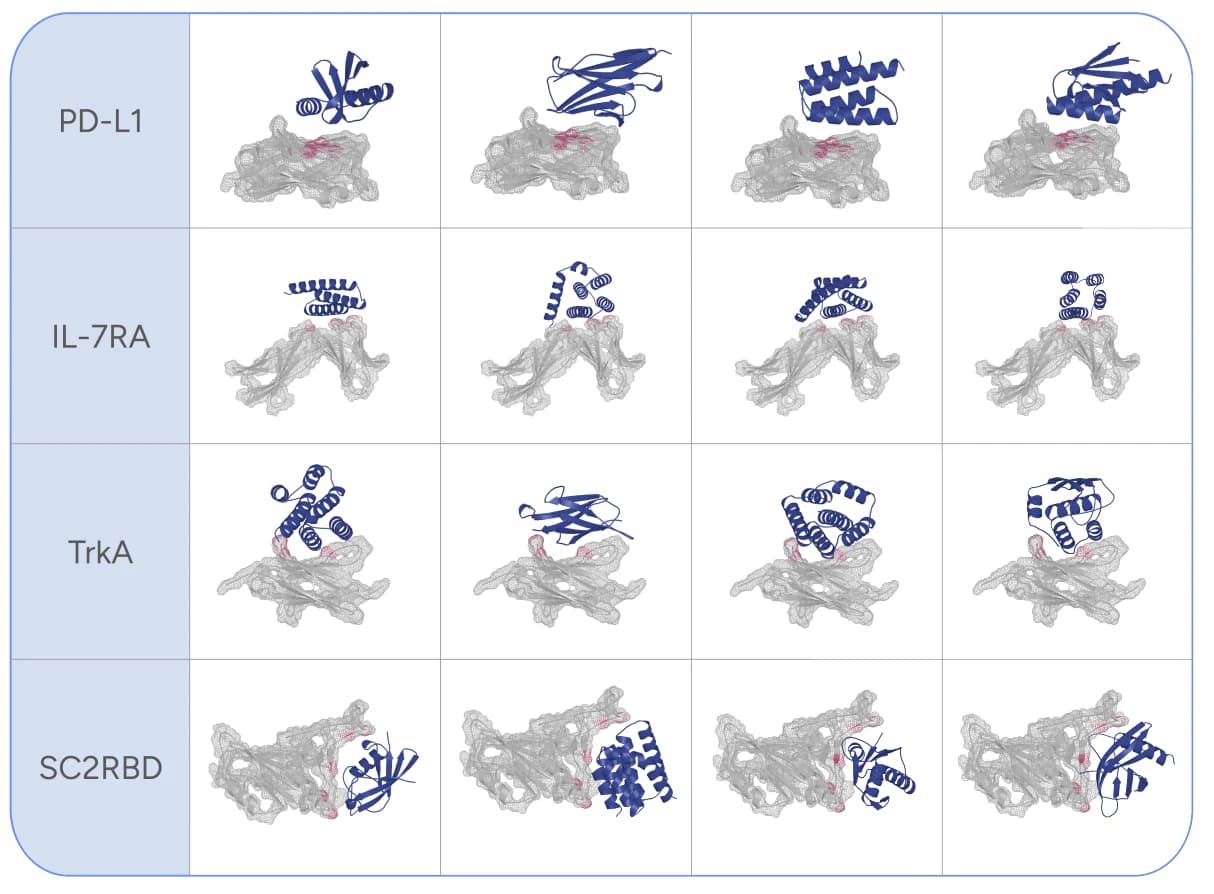
Generated examples from Dyno Psi-1, fine-tuned on the miniprotein design task, against PD-L1, IL-7RA, TrkA and the SARS-CoV-2 RBD. Hotspot residues on each target are in pink.
In conjunction, the team developed a quantitative yeast display binding assay that recapitulates gold-standard surface plasmon resonance (SPR) binding affinity measurements at orders-of-magnitude higher scale. With this assay, Dyno Psi-1 was benchmarked against BoltzGen head-to-head in the same experiment. Dyno Psi-1 achieves superior experimental performance, and that performance scales robustly with more computational screening.
Read and run it
- The whitepaper (PDF): model, training data and strategy, in silico and experimental benchmarking.
- Model weights and datasets on Hugging Face, and the inference package on PyPI as
dynopsi.